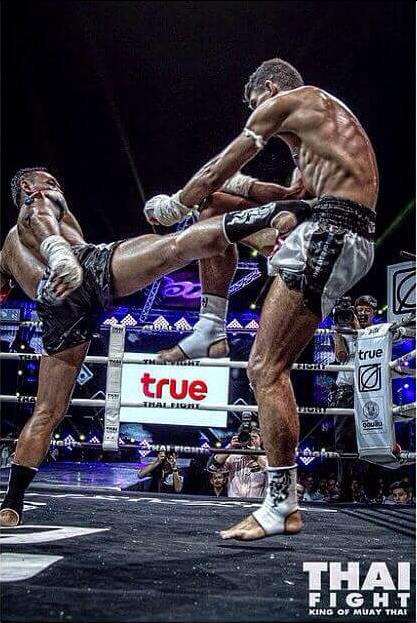
domingo, 17 de enero de 2016

Muay Thai Boxing Bangkok – Fears & Dreams / Los miedos y los sueños de los jóvenes boxeadores


The documentary “Fears and Dreams of young boxers” is a very nice video about two young Muay Thai fighters in Bangkok. They tell us their lifetime story and how they came to Muay Thai and how important the sport is in their lives. They report about the dreams to be a champion one day and to gain fame and honor. However, their fears and concerns remain not hidden …


El documental "Los miedos y los sueños de los boxeadores jóvenes" es un muy buen video sobre dos jóvenes luchadores de Muay Thai en Bangkok.
Ellos nos cuentan su historia de vida y cómo llegaron al Muay Thai y lo importante que es el deporte en sus vidas. Nos cuentan sobre los sueños de ser un campeón de un día y para ganar fama y honor. Sin embargo, sus temores y preocupaciones no queden ocultos ...


Credits:
Fears & Dreams of Young Boxers
The story of two young Muay Thai boxers. They tell us about their path, their fears, and their dream to one day become a champion.

Créditos:
Los miedos y los sueños de los jóvenes boxeadores
La historia de dos jóvenes boxeadores de Muay Thai. Ellos nos hablan de su pasado, de sus miedos, y su sueño de algún día convertirse en un campeón.


miércoles, 13 de enero de 2016

Learning How To Read Your Next Muay Thai Opponent - Aprende a leer a tu rival en Muay Thai


When you face someone for the first time are you aware of what is going on in your mind? Do you try to read your opponent to find any weaknesses in his game or does your brain turn off?

The answer to this question will likely depend on your experience level and your fighting style. Fighters who only use aggression in the ring, are less likely to read their opponent because they are only focused on their offense.

Reading your opponent does not happen over night. It is a process that is developed in training by practice and enhanced through experience.

When you first learn how to spar, your focus should be on simple execution and staying relaxed. The term K.I.S.S. (Keep It Simple, Stupid) should be the only thing going through your mind. Learning how to stay relaxed when someone is standing in front of you is the key element you want to work on.

Once you start becoming comfortable hitting and getting hit, you can start focusing on more advanced areas that can improve your game. Instead of just throwing strikes, the next stage is to learn how to LAND strikes. This requires you to develop better timing so that you know WHEN to strike and when not to strike.

After you begin executing your offense fluently, the next step is to learn how to start using your head when you spar.

Instead of trying to impose your will on opponent, you will start noticing what your opponent gives you and counter their tactics. Being able to expose weaknesses in your opponents and fight to your strengths, will make you a difficult fighter to face.

Reading Your Opponent Takes Practice

Do you remember the first time you learned how to read a language?

You might remember the painful process of having to sound out each letter as you attempted to form a word from the groups of letters (learning Thai is also pretty painful). Once you start becoming familiar with different words, you will start to recognize words when you see them, instead of having to sound them out.

Through practice and repetition, you slowly begin to add more words to your vocabulary. After enough practice, you will eventually have a full vocabulary and be able to read without having to “think” about reading.

Learning to think in Muay Thai is a similar learning process. The first time you try to read your opponent you might be able to “see” what is happening, but your brain will not be able to translate his movements (letters) into something that you can understand.

As you face different fighting styles and gain more experience, you will begin to recognize similar patterns that occur from person to person. Once you start recognizing specific patterns, combinations, and fighting styles, you will start understanding how you can adjust your game to match your opponent.

Over time, you will naturally start to counter your opponent without having to consciously think about what you are doing. Just like reading a language becomes second nature with enough practice, the same can be said about reading an opponent in Muay Thai.


An Example of Reading Your Opponent

Imagine you are sparring someone who keeps catching your right kick and sweeping you. The following are three different responses you might see.

Response #1 – The Beginner

As a beginner sparring, everything around you will happen at a lightning speed. You are at the survival stage of sparring and are trying make it through the round without getting hurt. You mind will not register that your kick is being caught because there are so many other things that are racing through your brain.

Beginners have to much going on in their minds to worry about trying to analyze their opponent. This is the equivalent to someone who is learning how to ride a bike attempting to learn tricks, before they can even balance the bike. You have to go through step A before you can get to step B.

Response #2 – The Hot Head

The second response is from someone who is a Hot Head (has a temper when they spar). This person gets swept repeatedly from their opponent and starts to get angry. After each sweep, they start to increase their power and try to go harder to get him back. Instead of using his brain when he spars, the Hot Head spars off instincts and emotions.

This fighter might recognize that his kicks are getting caught, but thinks the solution is to increase his power and try to catch his opponent’s kicks. The Hot Head will probably try to catch their opponents kicks and knock them on the ground, in order to get “even” on the score cards.

Response #3 – The Thinker

The third response is from someone who has learned to think in sparring. After his opponent catches his kick for the second time, he sees this pattern and looks to take advantage of it. In addition to seeing his opponent grabbing his leg, he also notices that his opponents hands drop every time he goes in for the catch.

Since he knows that his opponent wants to keep grabbing his leg and throwing him down, he adjusts his tactics to counter this. His next strike will be another kick, but instead of allowing his opponent to grab the kick, he will use it to set up another strike. When his opponent takes the bait on the third kick, he will use that bait to set up a strike to take advantage of his opponent dropping his hands.

The Thinker sees what his opponent is trying to do and adjusts his offense accordingly.

Now that you understanding the benefits of thinking when you spar, it is important to identify specific ways that you can learn how to read your opponent.


Here are some tips to help you read your next opponent:

1. Let Your Opponent Act First                 Photo Credit: agal photography


One of the best ways to train yourself to read your opponent is to let your opponent act first. While you might feel tempted to strike first because of habit, it is better to see what kind of game your opponent has first. Allowing your opponent to act first allows you to see what kind of tricks he might have up his sleeves.

Now when I say sit back and wait, I don’t mean shelling up in a ball like you are scared. If you shell up in a ball then your opponent will probably assume you are scared and will fight with more confidence. Waiting for your opponent to strike requires you to be confident in your defense regardless of who you are up against.

A side effect of allowing your opponent to strike first is that it puts your concentration on your defense. When you focus solely on defending, it makes it difficult for your opponent to land significant strikes against you. A strong defense will not only allow you to see what your opponent will do, it will also set a strong defensive tone at the start of the round.

Given the fact that the first round of sparring/fighting is often the most dangerous round because you don’t know what to expect, focusing on defense reduces the risk of a fast knockout in a 5 round fight.


2. Test Your Opponent                  Muay THai elbow test                       

In addition to allowing your opponent to work, you should also be testing their defense to find holes that you can exploit. Throw a body kick and see if your opponent blocks it. Does your opponent like catching your kicks? Is he constantly leaning back to avoid your kicks?
Testing someone’s defense means throwing strikes that are designed to give you feedback. Controlled, calculated strikes can help give you important information about your opponent.

When you watch experienced Thai fighters face foreigners in Thailand, you will often notice them throw calculated strikes to see how the foreigners respond. Since it is well known that foreigners don’t like elbow strikes, you will often see Thai fighters throw hard elbows and see if they can scare their inexperienced opponent.

If a foreigner responds to the elbow strike with fear and panic, the Thai fighters will attempt to exploit this advantage with hard elbow strikes designed to cut. If the Thai fighter is successful in exploiting this fear, there is a good chance the foreigner will “go down” to a punch or kick in order to end the fight.

If you don’t test your opponent’s defense, you will not be able to see how they react. So while it is important to read your opponent’s offense and see what they give you, it is also important for you to see what kind of defense you are working against as well.


3. Spar with New People                                 Photo Credit: Chok Chai Muay Thai Gym


When you spar with the same guys over and over, you already know their favorite weapons, their style and their tactics. Your regular sparring partners won’t do anything that you haven’t encountered before.

While it is great to have regular sparring partners that you train with, you also need to mix in new sparring partners so you can experience facing unfamiliar opponents.

Facing someone for the first time is like showing up for a blind date. You don’t know what to expect until you start sparring and see what your opponent has to offer. When you spar with someone new it gives you the opportunity to analyze your opponent from a blank slate.

The Harder the Sparring Session, the Harder It is to Think

It is worth pointing out that when you are technical sparring with no power, it is much easier to sit back and try to analyze your opponent. However, as soon as you add more power and the risk of being knocked out in a sparring session, suddenly thinking becomes much more difficult.

If someone is throwing strikes that could knock you out, your adrenaline level will increase, which causes your increased nerves, tension, and heart rate. Unless you are able to slow things back down, you will probably fight off instincts and won’t be able to use your head.

That is why you should focus on technical sparring first, before you try increasing the power and sparring at a harder level. Hard sparring without a good foundation will only make your technique worse and create bad habits.

Putting It All Together

Learning to think when you have someone trying to hit you takes practice. Before you learn how to think, you need to be able to stay relaxed. When you can slow your breathing down, it will work to reduce your nerves and allow you to use your head.

When you look at high level fighters like Saenchai or Yodsanklai fight, these fighters have so much experience that they can read their opponents without consciously trying to. Just like you can read the words that I am writing right now without any conscious thought, good fighters have enough experience that they don’t have to think about reading their opponent, they simply do.

This is the level that you should aspire to achieve as you continue to progress in Muay Thai. You should always go out and try to become a better version of yourself everyday in training, that is how you will make long lasting improvements.


Reglamento oficial del Muay Thai Profesional


Técnicas permitidas en combate


1) Agarrar la pierna del oponente cuando el mismo proyecta una patada. Se podrá mantener la pierna sujetada durante 3 segundos o 2 pasos adelante pudiendo contraatacar con las técnicas permitidas en el Muay Thai (codo o rodilla a la pierna tomada, puño al rostro, patadas circulares como Low Kick o High Kick, o proyectar al oponente haciendo que el mismo pierda el equilibrio.

2) Patadas frontales: Son permitidas como golpe siempre que superen la linea de la cintura. Es permitido frenar el avance de una patada circular utilizando la planta del pie (sobre el muslo o la cadera) siempre que no sea por debajo de la rodilla y que la intención de dicha patada frontal no sea de lastimar el muslo del oponente. El arbitro considerará la intención del golpe.


3) Patadas circulares: Podrán impactar en todo el cuerpo (por dentro y por fuera de la pierna, inclusive en la rodilla) exceptuando los genitales.


4) Bloqueos: Permitido bloquear los golpes con la tibia.


5) El Clinch: Los boxeadores podrán tomarse para golpear utilizando los golpes pactados (codos, rodillas, puños). De no producirse ningún golpe, tendrán un limite de tiempo de 5 segundos donde deberá intervenir el arbitro separándolos. Durante el clinch sera permitido trabar al oponente utilizando la pierna (tibia), para evitar el ataque de golpes de rodilla, pero siempre que la intención no sea de desestabilizar al oponente.

6) Proyecciones: Son de validez siempre que no se utilicen técnicas de Yudo (utilizar la cadera o enganchar con la pierna). Los arrojes son tomados con gran importancia por los jurados en la puntuación de las tarjetas y se contabilizará como caída.


7) Las rodillas: Podrán utilizarse para golpear siempre que el impacto no sea en la zona genital. Serán de gran validez en la obtención de puntos en las tarjetas. También se podrá tomar de la cabeza al oponente para bajarlo con el fin de golpearlo con la rodilla a la cabeza.


8) Los golpes en la espalda y nuca: Son tomados como válidos.


9) Empujar: Permitido para desestabilizar al oponente y conectar golpes.

10) Tomar de la guardia: Para conectar golpes de codos o de rodillas.

martes, 12 de enero de 2016

5 BASIC MUAY THAI WORKOUTS


Get started with a basic training routine that you can do on your own or with a buddy.


These 5 basic training workouts here are focused on getting you started and building and developing a training foundation, to start building muscle endurance, losing weight and burning calories to get you in better overall shape.
Even if you are a beginner in martial arts Muay Thai. With anything new… Start slow and go at your own pace. And consult your physician before you begin any of these exercises.
These are some of the basic training routines that my beginner’s at my gym do. And it will give you an idea on how Muay Thai fighters train. Go at your own pace. And know that you don’t have to do ALL of them. This is just a basic layout of some of the routines you can perform.
I’ve added youtube videos of some of the best fighters training. Check them out.
Above all have fun and enjoy the journey.
The first and most important part of the training is to do a proper warm-up and stretch before you start to try these martial art techniques. Warming up will actually increases your performance and reduces the chance of injury. Remember you are just learning these techniques so take your time GO SLOW and really focus on the techniques for now.

Stretching Before You Begin:

Start your stretching by using controlled, leg and arm swings that make use of your body’s natural range of motion. Like arm swings, truck rotations, and twists. This is called Dynamic stretching. Don’t force your muscle past your own range of motion. That comes after the workout.
  • Circle your arms forward and backwards about 8-10 times each
  • Rotate your neck up and down, side to side, left to right.
  • Truck rotations 8-10 times.
  • Frankenstein’s: Stand shoulder width apart, hands out in front and lift your foot to your hand in a swinging motion. Don’t forget to go backwards too.
  • Leg rotations: Step on the ball of the foot and rotate your leg back and forth like your putting a cigarette but out. 8-10 times each leg.

Road Work:

Getting your road work in is a big part of Muay Thai training. This will help increase your conditioning and build strong shins for kicking.
Start small. Don’t measure the distance. Measure your time.
Maybe 10 minutes of light running (you don’t have to go full out sprints) 3 times a day after your stretching. And add 2 minutes with each new run, until you hit up to three mile. Try and run outside if you can, early in the morning when the sun is not beam down on your back. Running will help a lot with your cardiovascular training. You will be able to last longer hitting the bags, Thai pads, and fighting inside the ring or in a self defense situation. It will also help strengthen your leg muscles, which is a must for Muay Thai.
It takes a while to get used to, but I can tell your right now it will be one of the best benefits you’ll gain. It will help get your busy day started along with your training, and have a better peace of mind. Like meditating — it’s one place your don’t have to think about anything.

Shadow Boxing:

Shadow boxing is one of those things that you Have To Do in order to practice and perfect ALL of your Thai boxing techniques. It helps you to develop your strategies against any type of opponent.
If you can, try shadow boxing in front of a mirror (your local gym or Muay Thai school should have one). This will help to make sure that your executing your martial arts techniques correctly from every angle. If you see a mistake in your attack or defense, fix it. The mirror never lies.
Stand in your basic fighting position and go through all the Thai Kickboxing techniques you know. Don’t worry about looking silly. EVERYONE does their first time. As you get better start picking up your speed (keep proper form and periodically check yourself in the mirror for mistakes) and imagine fighting someone in front of you. Make it as realistic as you can, moving your feet and head and mixing the punches and kicking for good combinations. Try and go for 2 or 3 rounds with 3 minutes on and a 1 minute break.

Rope Skipping:

Jump roping is also a vital part to your training. No this isn’t the type of jumping roping you did in grade school. This type of training not only provides great stamina, but it also helps build hand-eye-coordination, and builds strong shoulder, wrists, forearms, calf and leg muscles too.
Constantly mixed up your footwork… Bounce with both legs, one leg, move forward, backward, side to side, bring the knees high to your chest, chris-cross if you want to get fancy. Just make sure your always changing your rhythm. Try 3 minutes, one minute rest for 2 to 3 rounds.

Bag Work:

The bag training is great for practicing your punches, kicks, knees and elbows. Hitting the bag will give you a better realistic feeling on fighting an opponent and at the same time give you a great workout. The benefits of bag training will improve your movement and timing coordination. It’ll also build stamina in your shoulders and legs with each strike you throw, which in turn will add more power to your Muay Thai punches and kicks.
When working on the Thai bag remember to always wrap your hands to protect your knuckles and wrist from taking damage. And again, take your time. You don’t have to go ROCKY style on the bag. Work on executing clean, technical punches and kicks. Perfect your form. The speed and power comes later. Try going 3 rounds on the bag mixing in all attacks. And don’t forget your footwork and head movement.

Muay Thai Pad Work:

I’m not going to talk about pad work here. I’ll save that for another blog. Pad training is a more advance method of working out, and should only be done with someone who knows what their doing. Ask your Kickboxing coach (Kru) to set some time aside to hold pads for you.
Muay Thai Pad training is an art in-it-self, and takes a lot of time and constant pad holding the master. A good pad trainer will mix up all the different techniques. Offense and defense to simulate different situations you might find yourself in a real fight. They’ll even dissect what your strengths and weaknesses are and come up with a Muay Thai fighting style that best suits you.
Here’s a basic training routine you can start doing right away.
  • Start with a 10-20 min. jog (depending on your current condition)
    10 min. stretch
  • 3 rounds of jump roping for 3 mins. with a 1 min. rest
  • 3 rounds of shadow boxing for 3 mins. with a 1 min. rest
  • 3-5 rounds of pad work for 3 mins. with a 1 min. rest
  • 3-5 rounds of drilling techniques on your own or with a partner
  • 100 knees, 100 round kicks, 100 push kicks on the heavy bag
  • Conditioning – 50-100 crunches, 20 push-ups, 30 squats
  • End with a 10 min stretch

5 TIPS PARA MEJORAR EL ENFOQUE Y CONCENTRACIÓN EN LOS ROUNDS DE SOMBRA


Se que te dices por que hacer sombra?realmente es aburrido prefiero centrarme solo en las tecnicas de muay thai....Si a alguien no le da la gana de hacer sombra,no sabe  que afecta negativamente a su técnica de muay thai. La mayoría de la gente piensa que es aburrido y sólo un calentamiento para la sesión de entrenamiento de muay thai real ... pero no lo es.

Round de sombras el mejor lugar para llevar a su técnica de muay thai al siguiente nivel. Si se toma el tiempo para fluir con sus técnicas y sentir cómo sus músculos, articulaciones y extremidades se mueven, te volverás más consciente de sí mismo, que es clave para ser su propio maestro.
Los 5 mejores consejos Shadowboxing:

¿Cómo obtener el máximo provecho de su boxeo de sombra?

1) Concentrate y dedica un tiempo y enfocate en hacer sombra. Si te dejas llevar por los movimientos y hacer una o dos rondas de boxeo de sombra sin poner tu mente en ella , estas perdiendo puntos y sobre todo tu tiempo.

Comience por aflojar los hombros, la apertura de las caderas y el ser de luz sobre las puntas de los pies. Una vez que comience a entrar en calor y luego comenzar a comenzar realmente a añadir tecnica. Ajuste su jab, gire sus caderas en cada golpe, de pivote en su gancho de izquierda, etc.


3) Implementar maniobras defensivas. Es probable que usted no va a estar en una pelea en la que su oponente es una pequeña perra asustada y no lanzar ningún ataque a usted. Hágase un favor, mientras hace su boxeo de sombra y entrene defensa de unas cuantas patadas, tener un poco de movimiento de la cabeza y usar su trabajo de pies para entrar y salir de la distancia de ataque


4) Tiempo en Sombra. Baso mi boxeo de sombra sobre el tipo de pelea que he subiendo (por lo que 3 o 5 rondas de 2 minutos con un descanso de 1 minuto), de esta manera mi cuerpo y la mente se acostumbra a la vez.


5) Haz sombra como si estuvieras luchando. En la fase de calentamiento que usted no tiene que ir al ataque siempre, pero a medida que comienza a trabajar realmente en él, entonces realmente debe empezar a pensar en el plan de juego que desea implementar y tratar de hacer eso contra de su oponente falso. El trabajo sobre defensa, fintas y la creación de ciertos ataques.


DESPUES DE 21 AÑOS SE VUELVEN A ENCONTRAR : SHAMROCK VS GRACIE - FEBRERO 19 2016


Los históricos luchadores de artes marciales mixtas (MMA) Royce Gracie y Ken Shamrock se enfrentarán por tercera vez 21 años después de su última pelea.

Este será el combate estelar del evento de Bellator –compañía que compite en Estados Unidos con la UFC– programado para el 19 de febrero del próximo año.

El anuncio ha generado críticas de algunos fans de las MMA, pues Gracie cumplirá 49 años en diciembre próximo, mientras que Shamrock cumplirá 52 años dos días después de la pelea.

Además, Royce Gracie –tres veces ganador del UFC en su primera etapa– no ha competido desde junio del 2007, cuando enfrentó por segunda vez a Kazushi Sakuraba en el "Dynamite!! USA". El brasileño ganó por decisión de los jueces, pero dio positivo a un control antidopaje posterior al combate.

Roy Gracie vs Kazushi Sakuraba


Ken Shamrock sí ha tenido continuidad en las MMA. En junio pasado fue derrotado por Kimbo Slice vía nocaut técnico en el evento "Bellator 138". El desempeño de la ex estrella de la WWE fue criticado por los expertos.

Ken Shamrock vs Kimbo Slice

Rivalidad eterna
La primera pelea entre Gracie y Shamrock fue en la semifinal del UFC 1 (1993). En aquella ocasión, el brasileño derrotó al estadounidense en el primer asalto con un ahorque mataleón (rear-naked choke).

El segundo combate fue en el UFC 5 (1995) y duró 36 minutos. Fue declarado empate, pues no hubo jueces. Aunque Shamrock –mucho más pesado y fuerte– se llevó la mejor parte, no pudo someter ni noquear a su rival.


lunes, 11 de enero de 2016

Myanmar-Lethwei-Boxing: Nueva Arte marcial Asiatica que es sensación mundial.

Han pasado más de 20 años desde que luchó en un Ring de arena.... pero Lone Chaw todavía recuerda los lotes pueblo polvoriento de su juventud, sin marcar a excepción de huellas manchados por el sudor y la sangre. Estampado sobre en un ritual conocido como "lat kha maung", que golpea las palmas abiertas contra sus codos, imitando las alas de un gallo de pelea, como  el intento de convocar a su espíritu.


WIN TUN(BLUE) VS LONE CHAW(RED)


Lat Kha Maung se realiza antes de los combates como una especie de ritual que se originó en aldeas agrícolas.

Este es el camino correcto de Lethwei - forma tradicional de Myanmar del boxeo.
Oculto en el resto del mundo durante décadas, el deporte  propio de Myanmar, está experimentando un renacimiento y redescubrimiento tanto en casa como en el extranjero.
En agosto, el Woodlands Sports Hall de Singapur organizó un puño limpio Lethwei retador lucha internacional.

Eventos similares en el Bangkok han ayudado a marcar el comienzo de una nueva era para Lethwei.
que lleva una hisoria rica y que hoy dia se da a conocer al mundo,aquellos peleadores que ahora se dedican a entrenar,con un turismo que se ve e incremento como sus campos de entrenamiento aunque en el mismo birmania se entrena hasta en la calle,es el deporte nacional y el que genera mucho interes,por todo lo que mueve este deporte que va generando no solo ineteres sino mucho dinero,epa casas de apuestas.


Si eres amante de los deportes de contacto un viaje con training incluido a Birmania y practicar Lethwei incrementa nuestra sabiduria y escencia en el ring.


Lethwei (Birmania) Bareknuckle(nudillos desnudos)es un arte marcial sin armas de birmana. Es similar a los estilos relacionados de kickboxing de Indochina, Muay Thai de Tailandia, Pradal Serey de Camboya, Muay Lao de Laos y Tomoi de Malasia,también se conoce como el boxeo birmano o Myanmar nudillo desnudo boxeo.


Lethwei tiene menos restricciones que el Muay Thai, ya que permite técnicas como cabezazos. Además, los participantes en las competiciones Lethwei tradicionales luchan sin guantes. Sin embargo, tenga en cuenta que los guantes se utilizan cada vez en competiciones Lethwei modernas con el fin de que sea más de un deporte más popular a nivel mundial.


Tway Ma Shaung, El rey de Lethwei,el mejor peleador de Bareknuckle en el mundo.


Según la Red de la Asociación Americana de Myanmar, "Tradicionalmente, los combatientes Lethwei no pelean con los guantes, y utilizan una gran cantidad de otros componentes tales como lanzar, asfixia y la cabeza colillas. A un nivel más elemental, el momento y la intensidad son la lucha contra la mucho mas rápido".


En la antigüedad, se celebraron peleas para el entretenimiento y eran populares entre todos los estratos de la sociedad. 


La participación se abrió a cualquier hombre, ya sea rey o plebeyo. En ese momento, los partidos tuvieron lugar en cajones de arena en vez de anillos. Los boxeadores pelearon sin equipo de protección, solamente envolviendo sus manos en el cáñamo o gasa. Allí no habian empates y ningún sistema de puntos, la lucha continuó hasta que uno de los participantes fue eliminado o ya no podía continuar. En aquel entonces, los campeones de boxeo birmano entraban a competencias y la convocatoria de retos abiertos.
Kyar Ba Nyein, que participó en el boxeo en los Juegos Olímpicos de Verano 1952, fue pionera Lethwei moderna mediante el establecimiento de unas normas modernas y regulationes.
 viajó por Myanmar, especialmente el Mon y Karen estados donde muchos de los aldeanos seguían practicando activamente Lethwei. Kyar Ba Nyein los trajo de vuelta a Mandalay y Rangún y, después de entrenar con ellos, les animó a competir en los torneos que organiza.

El gobierno de Myanmar ha hecho algunos cambios en la organización para que el boxeo birmano más comercializables internacionalmente. Hay una serie de boxeadores birmanos que compiten en Tailandia profesionalmente con distintos grados de éxito.
El primer torneo de campeonato Lethwei se celebró en 2000. En los combates ordinarios no existe un sistema de puntuación, pero se adoptó entonces. Los combates de títulos oficiales no se han celebrado desde el campeonato así que los que noqueó a los ganadores del torneo se consideran los campeones no oficiales. Aunque sólo dos o tres eventos oficiales se llevan a cabo por el gobierno de cada año, los partidos no oficiales se llevan a cabo en los festivales de todo el país cada mes.

En peleas patrocinados por el gobierno, ambos competidores se dan cinturones como regalos conmemorativos. Los ganadores se dan cinturones de color negro, y los perdedores se les da cinturones de color blanco.


El primer evento internacional Lethwei se celebró en junio de 2001 cuando tres kickboxing de los EE.UU. compitieron contra los practicantes Lethwei. Eran Shannon Ritch, Albert Ramírez y Doug Evans. Los tres estadounidenses fueron eliminados en la primera ronda. El segundo de estos eventos tuvo lugar el 10 a 11 julio, 2004 cuando se ofrecieron cuatro luchadores japoneses para luchar contra boxeadores birmanos. Eran Akitoshi Tamura, Yoshitaro Niimi, Takeharu Yamamoto y Naruji Wakasugi. Tamura, un artista marcial mixto, noqueó a Aya Bo Sein en la segunda ronda y se convirtió en el primer extranjero en ganar a un practicante Lethwei en un match oficial.


TECNICA ....